Article URL: https://everydaywerk.com/vinted-review/
I've had a Vinted account since 2018, but my first attempt at selling there didn't result in a single sale. Now Vinted is getting much more attention in the U.S. - and its promise of no seller fees definitely got mine. So I took another look at how Vinted works in 2026, what buyers actually pay and whether it's worth adding to your resale rotation.
Quick Take
I first listed about 10 items on Vinted back in 2018. My listings weren't invisible. I remember getting plenty of favorites. What I didn't get were sales.
I don't know why those listings didn't ultimately sell on Vinted. What I do know is that some of the same items later sold successfully on other resale platforms.
The same item can perform very differently from one marketplace to another.
That's why I'm taking another look now. Vinted's current U.S. model is unusual: sellers can list and sell without a standard selling fee, while buyers pay a separate Buyer Protection fee. That makes Vinted interesting - but a fee structure alone doesn't tell you whether your item will actually sell.
My question isn't simply, Where can I list this for free? It's: Where is the buyer for this particular item?
Table of Contents
- Quick Facts: Vinted in 2026
- I Tried Vinted Before All These Commercials
- The Big Vinted Selling Point: No Seller Fees
- What Actually Sells Well on Vinted?
- How Vinted Visibility and Offers Work
- Shipping, Payments and Buyer Protection
- What I Like — and What I'm Still Watching
- How I'd Use Vinted in My Resale Rotation
- So, Is Vinted Worth It in 2026?
Quick Facts: Vinted in 2026
| Best for | Testing pre-loved clothing and other eligible secondhand items with a no-standard-seller-fee model |
| Cost to list | Free |
| Standard seller fee | None under Vinted's current U.S. model |
| Buyer fee | Buyer Protection; usually 5% of the item or bundle price + $0.70, with exact calculation shown at checkout |
| Shipping | Buyer generally pays; Vinted provides shipping instructions/prepaid label for integrated shipping |
| Ship-by window | 5 business days, unless an extension is agreed |
| Getting paid | Funds remain pending until the order is completed; payment then moves to available balance |
| Bank withdrawal | May take up to 5 business days |
| My experience | About 10 listings in 2018; favorites, but no completed Vinted sales |
I Tried Vinted Before All These Commercials
When Vinted started showing up on my radar again, I had one of those moments where I thought, Wait - I know that name.
I went back through my old records and realized I had actually listed roughly 10 items on Vinted in 2018. They weren't all the same kind of item or the same price. I had handbags and accessories, shoes and other pieces I was ready to let go.
And people noticed them. I received favorites on multiple listings.
But none of those favorites became a completed sale for me.
Some of those items later sold on other resale platforms. I don't know why they didn't sell on Vinted, and I don't need to invent an explanation. That's part of resale: the same item can perform differently from one marketplace to another.
A favorite isn't a sale.
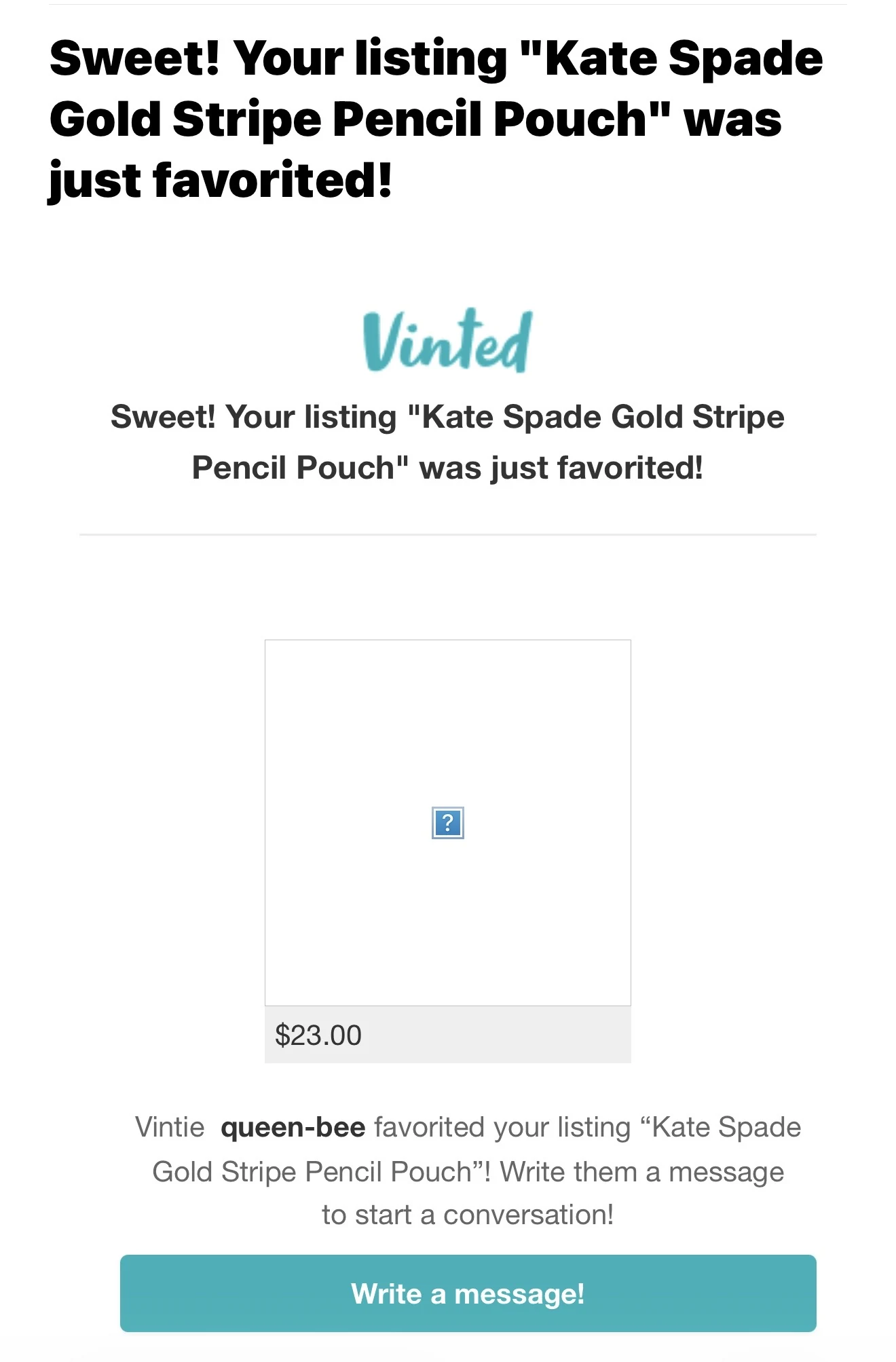
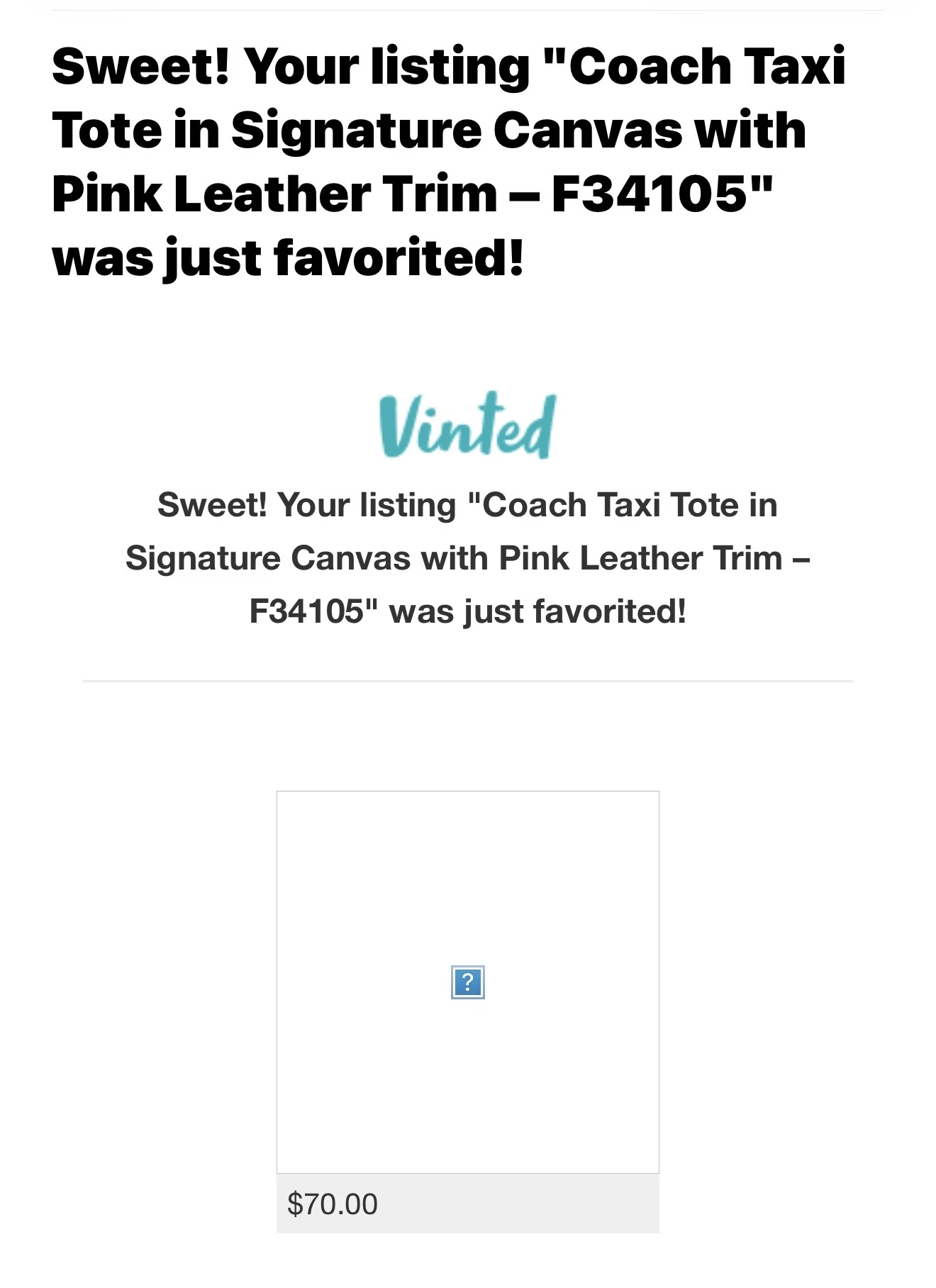
Receipts from my original Vinted experience: These archived Vinted emails show favorites on two of the items I listed when I first used the platform. The original product images no longer load in the old emails, but the listing names, prices and favorite notifications remain. Despite receiving interest, I didn't complete a sale on Vinted. Screenshots: Joi Elle/Everyday Werk.
The Big Vinted Selling Point: No Seller Fees
The feature that immediately makes Vinted stand out in 2026 is simple: under its current U.S. model, there is no standard listing fee and no standard selling fee deducted from the seller's item price.
If an item sells for $40, the seller isn't starting the math by subtracting a 10%, 15% or 20% marketplace commission from that $40.
That matters. Especially when you're selling things you already own and trying to recover as much usable value as possible.
But I wouldn't choose a marketplace based on fees alone.
The lowest fee doesn't automatically produce the highest return.
Keeping a larger percentage of a sale is valuable only if the item actually sells at a price you're willing to accept.
No Seller Fee Doesn't Mean No Marketplace Fee
Vinted's no-seller-fee message can sound like the transaction is fee-free. It isn't.
Vinted charges buyers a mandatory Buyer Protection fee on purchases made through its system. Vinted says the fee usually includes 5% of the item or bundle price plus $0.70, although the exact calculation can vary and is displayed to the buyer.
That distinction matters because buyers shop based on their total cost, not just the number you typed into the listing.
A $20 asking price is not necessarily a $20 checkout. The buyer may also see Buyer Protection, shipping and applicable taxes.
So when I'm evaluating Vinted, I'm thinking about both sides of the transaction: what I keep and what the buyer ultimately has to pay.
What Actually Sells Well on Vinted?
Spend some time in current seller conversations and you'll find plenty of discussion about bargain hunting and relatively inexpensive merchandise. Some sellers report successfully moving lower-priced items, while others say they receive plenty of offers and engagement from price-conscious shoppers.
That's useful anecdotal information.
It is not proof that inexpensive items inherently perform better on Vinted, and I'm not going to turn it into a rule that says, “cheap things go on Vinted.”
Instead, I'm coming back to a question I've learned to ask across resale platforms:
Where is the buyer for this particular item?
The right answer may change by brand, category, condition, season, price, demand and the audience already shopping on a particular marketplace.
A Favorite Isn't a Sale
My old Vinted emails are a good reminder of something that's easy to forget when you're selling online: activity can feel like progress even when it isn't income.
A favorite tells me someone noticed the item. An offer tells me someone is considering a transaction. A message can indicate interest.
But none of those things puts money in my account.
An asking price isn't money. A sold item is.
That doesn't mean favorites are useless. They can tell you that your listing is being seen. They may create opportunities to engage with potential buyers. But I don't count interest as earnings.
New Sellers May Get a Visibility Advantage
Vinted's own explanation of its recommendation system acknowledges that user history can affect which listings people see. It also says that being a new member can help visibility by allowing Vinted to promote listings to people who have viewed or purchased similar items.
Vinted doesn't publicly specify exactly how much additional visibility a new member receives or precisely how long any new-member advantage lasts.
And because my own account dates back to 2018, I wouldn't assume that I personally receive the same treatment as someone opening an account today.
More visibility is an opportunity. It's not a buyer.
Vinted's Algorithm Gives Us Some Clues
Vinted says recommendations can take into account factors such as what members search for, view, favorite and buy, along with information about listings and member activity.
For a seller, that reinforces something fairly practical: the basics still matter. Use accurate categories. Write a clear description. Photograph the actual item well. Set a price you can defend. Make it easier for the marketplace - and the buyer - to understand what you're selling.
Vinted also sells optional Bumps, which can place an item higher in feeds and search results for 3 or 7 days, or until it sells. That's paid visibility, not a guarantee of a transaction.
Vinted Is About More Than Clothes Now
Vinted may still be strongly associated with fashion, but its current U.S. catalog extends beyond clothing.
Depending on Vinted's current Catalog Rules, eligible listings can include categories such as home and kitchenware, books and media, hobbies and collectibles, sports equipment, children's items, pet-care items, electronics and certain new beauty products.
That makes the platform more interesting to me because my resale inventory isn't limited to a closet. I look around the entire house for things that still have value but no longer have a job in my life.
Always check the current Catalog Rules before listing, because permitted and restricted items can change.
Offers Are Part of Vinted, Too
Vinted allows buyers to make offers below the listed price. Under the current rules, an offer can be as much as 40% below the original price.
But an accepted offer is not the same thing as a completed purchase. Offers are nonbinding. Even after a seller accepts one, the buyer still has to press Buy now and finish the transaction.
That's another reason I wouldn't mentally spend the money just because someone made an offer.
Bundles Could Make Smaller Sales More Interesting
If I'm listing several lower-dollar items, bundles are one feature I'd pay attention to.
A single inexpensive item may or may not feel worthwhile once I consider the time to photograph it, write the listing, pack it and ship it. If a buyer wants several items, however, the economics of my time can start to look different.
That doesn't mean I would slash prices just to create a bundle. It means I'd consider the value of moving multiple things in one transaction when the numbers make sense.
Shipping Is Relatively Straightforward
With Vinted's integrated shipping, the buyer generally pays shipping and chooses from the available delivery options. After a sale, the seller receives shipping instructions and, for applicable integrated methods, a prepaid Vinted-generated label.
Sellers generally have 5 business days to ship. If more time is needed, Vinted provides a process for requesting an extension from the buyer.
Vinted also recommends photographing the item and the packed parcel before shipping. That's a habit I like on any resale platform because documentation can matter if something goes wrong in transit.
You Don't Get Paid the Moment Someone Buys
A sale notification is not the same thing as immediately available cash.
When a buyer pays, the money initially appears as pending in the seller's Vinted Wallet. After delivery, the buyer has a window to complete the order or report a problem. Once the order is completed, Vinted says the payment moves to the seller's available balance.
From there, a bank withdrawal may take up to 5 business days.
That timing matters if you're reselling because you need money by a specific date. Marketplace earnings can be useful, but they aren't the same as cash already sitting in your checking account.
What Happens If Something Goes Wrong?
Vinted's Buyer Protection applies to purchases completed through its Buy now system. Under the current refund policy, buyers can seek a refund for issues such as an item that was never shipped or was lost, arrived damaged, or was significantly not as described.
For sellers, that makes accurate descriptions and good documentation especially important.
Photograph flaws. Describe condition honestly. Use the correct shipping process. Keep evidence of how the item looked and how it was packed.
The goal isn't to make a listing sound perfect. The goal is to make it accurate enough that the buyer knows what they're buying.
What I Like About Vinted So Far
The no-standard-seller-fee structure is genuinely compelling. I also like that buyers generally cover shipping, that the platform now supports a broader range of categories, and that Vinted gives sellers tools such as offers, bundles and optional visibility boosts.
Most of all, I like having another marketplace to test.
I don't need one resale app to be the winner for everything I own. I need enough options to make a thoughtful decision about where a particular item has the best chance of finding the right buyer.
What I'm Still Watching
I'm still watching how Vinted's current U.S. audience develops, what kinds of items consistently find buyers, how much negotiation becomes part of the experience, and whether the buyer-side fees affect what shoppers are willing to pay.
I'm also keeping my own history in perspective. My experience from 2018 is real, but it isn't a controlled test of Vinted in 2026.
That's why I'm comfortable saying I'm interested in testing Vinted again without pretending I already know how every category will perform.
How I'd Use Vinted in My Resale Rotation
I wouldn't move every listing I own to Vinted simply because there is no standard seller fee.
I'd test it selectively. I'd start with eligible items I already own, pay attention to the type of engagement they receive, compare actual offers and completed-sale results with my other marketplaces, and adjust from there.
The goal isn't to collect marketplace accounts.
The goal is to convert things I'm no longer using into money I can actually use.
Before You Buy Inventory, Sell What You Already Own
This is one of the biggest principles behind the way I think about resale.
Before you buy inventory, source pallets, fill a spare room with merchandise or turn reselling into another job, look around your own house.
Your closet. Your shoe rack. Your handbags. Electronics you've upgraded. Decor you've replaced. Hobby supplies. Books. Things you bought with good intentions and barely used.
You already paid for them.
Some of that value may still be recoverable.
That doesn't mean everything should be sold. Some things are better donated, gifted, recycled or simply kept. But it's worth taking inventory before assuming that making extra money always requires taking on something new.
Bridge the gap when you need to. Build the cushion when you don't.
So, Is Vinted Worth It in 2026?
I think Vinted is worth testing.
That's different from saying every item belongs there.
My first Vinted attempt years ago produced favorites but no sales. I don't know why, and I'm not going to rewrite that history to fit today's marketplace.
What has changed is that Vinted now gives U.S. sellers a compelling reason to look again: a current model with no standard seller fee, a broader catalog than many people may remember, and tools designed to help buyers and sellers complete secondhand transactions.
For me, the smartest approach is not loyalty to one resale app. It's matching the item to the marketplace and measuring what actually happens.
Because ultimately, the question isn't:
Where can I list something for free?
It's:
Where can I turn something I'm no longer using into money I can actually use?
And if Vinted can do that for some of the things already sitting in my house, it has earned a place in my resale rotation.
Editorial disclosure: This review reflects my personal experience and independent research. No affiliate or referral relationship is implied unless one is clearly disclosed on the published article.