Article URL: https://everydaywerk.com/offerup-review/
I've used OfferUp for years to sell furniture, electronics and other things around my home that I'd rather not pack and ship. Some things have sold relatively quickly. One pair of tables took nearly three years to find its buyer. Here's what that's taught me about local demand, pricing, patience and knowing when you simply want something gone.
Quick Take
I've sold a pretty wide mix of things on OfferUp: furniture, electronics, shoes and household items. I've also listed clothing, dinnerware and other things around my home.
That's one reason I don't think of OfferUp as a marketplace for one particular category. I think of it as a marketplace for a particular kind of transaction:
I have something. Someone near me wants it. We agree on a price. We meet. The item leaves with them and I get paid.
That's especially attractive when the alternative involves finding a box, figuring out shipping dimensions, paying for packing materials or trying to ship something I have absolutely no desire to ship.
But I've learned something else from using OfferUp:
Local doesn't necessarily mean fast.
One pair of side tables I listed in October 2022 accumulated more than 1,000 views and 13 conversations. They eventually sold - in June 2025. Nearly three years later.
That experience changed the way I think about local selling. If I don't urgently need something out of my house, sometimes I'm perfectly willing to list it and let the right buyer find it. If I need it gone by Saturday? That's a different strategy.
Table of Contents
- Quick Facts: OfferUp in 2026
- Sometimes the Thing Worth Selling Isn't in Your Closet
- The Tables That Took Almost Three Years to Sell
- Time, Price and Space
- Why OfferUp Works for Things I Don't Want to Ship
- Pricing, Negotiation and Local Demand
- Payment, Communication and Meetup Safety
- Active Listings and Paid Visibility
- So, Is OfferUp Worth It in 2026?
Quick Facts: OfferUp in 2026
| Best for | Furniture, electronics, household goods and other things you want to sell locally |
| Cost to start selling | Free within OfferUp's monthly listing allowances; limits vary by category |
| Commission on local sale | None |
| Shipping | No nationwide shipping; OfferUp is now focused on local, in-person transactions |
| Payment | In person; OfferUp recommends cash |
| Getting paid | At the meetup when the transaction is completed |
| Communication | Keep it inside OfferUp's messaging system |
| Safety | Public meetup strongly recommended; OfferUp provides Community MeetUp Spots |
| My experience | Successful sales across furniture, electronics, shoes and household items - with very different levels of interest and time-to-sale |
| My take | Particularly useful when something has value but shipping it would be expensive, inconvenient or simply not worth the trouble |
OfferUp currently allows a certain number of free listings each month, with the allowance varying by category. Sellers who exceed an applicable allowance can purchase additional listings. OfferUp does not charge a commission on an in-person transaction. Optional paid products - including promotions and additional listings - are available, but you do not have to purchase them to start selling.
Sometimes the Thing Worth Selling Isn't in Your Closet
When I started looking around my house differently - asking what I owned that I wasn't using but someone else might pay for - I quickly realized something.
Not everything fits neatly into a box.
There's furniture. Home decor. Electronics. Dinnerware. Larger household items. And things that technically could be shipped, but would cost so much or require so much work to pack that I simply don't want to do it.
That's where OfferUp has served a very different purpose for me.
I've successfully sold furniture, electronics, shoes and other items there. And when I look at my OfferUp history, one thing becomes obvious: different items behave very differently in the same marketplace.
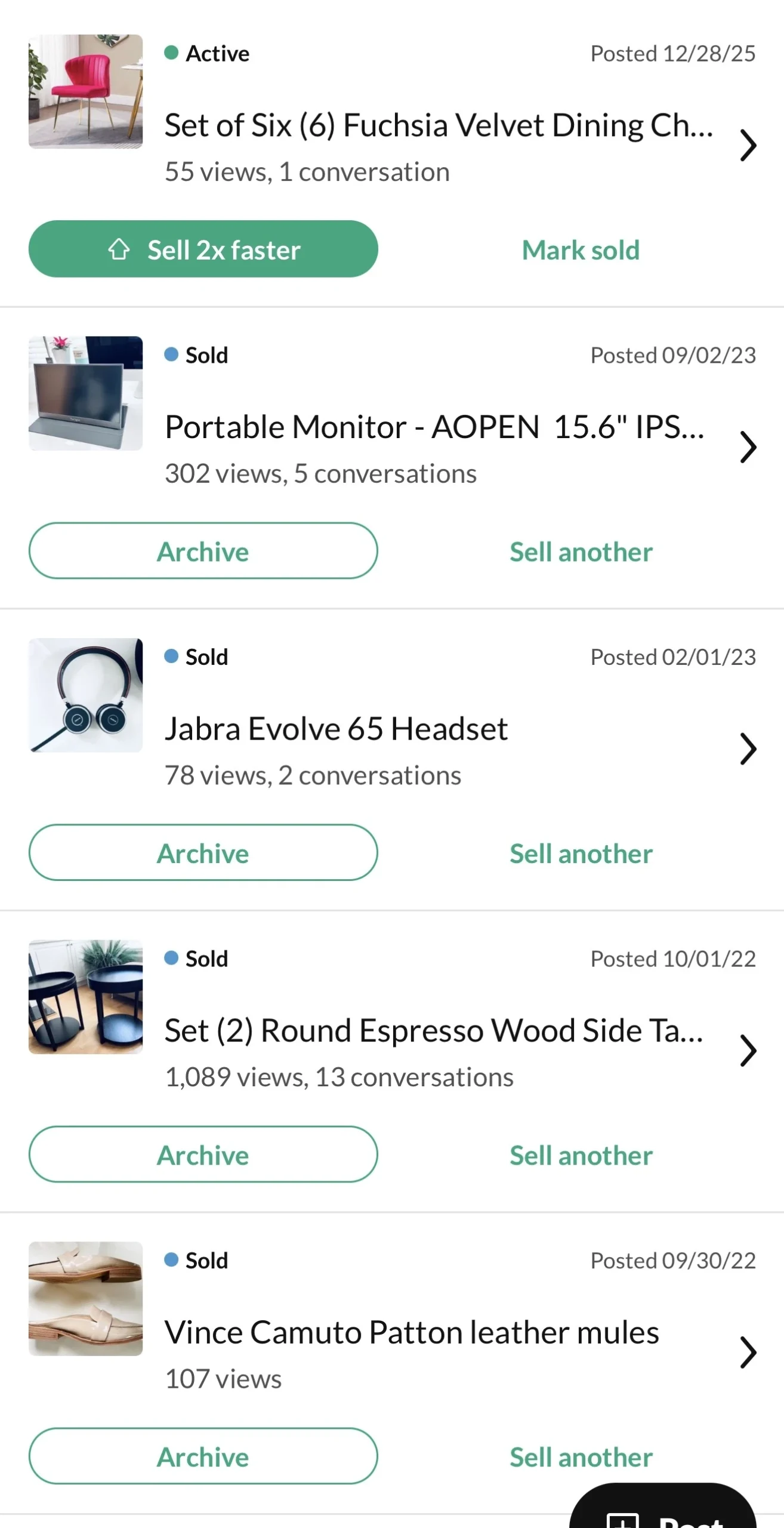
One of my portable monitors sold after receiving 302 views and five conversations. A Jabra headset sold after 78 views and two conversations. A pair of shoes sold after 107 views. And then there are my round espresso wood side tables.
Those had 1,089 views and 13 conversations. They sold, too. Eventually.
Attention isn't the same thing as a buyer.
The Tables That Took Almost Three Years to Sell
I listed a set of two round espresso wood side tables on OfferUp in October 2022.
They weren't invisible. More than 1,000 people viewed the listing. I had 13 conversations about them.
But the tables didn't actually sell until June 2025. Nearly three years.
That might sound ridiculous if your goal is to declutter your house this weekend. But I wasn't in an urgent rush to get rid of them, so I let the listing sit.
Eventually, someone needed exactly what I had.
That's something I've had to remind myself with OfferUp: go ahead and list it. If I still have the item anyway, leaving it available gives a future buyer the opportunity to find it.
Not selling this week doesn't necessarily mean it won't sell. Not selling this year apparently doesn't always mean it won't sell either.
But How Long You're Willing to Wait Changes the Strategy
There's an important caveat to my three-year table story: I could afford to wait.
If I were moving next weekend, downsizing, clearing a room or simply tired of looking at those tables, waiting nearly three years would make absolutely no sense.
That's why I've started thinking about local selling as a tradeoff between three things: time, price and space.
If maximizing what I receive matters most, I may be willing to give the right buyer more time to find the listing. If speed matters most, I may have to price the item more aggressively. And if reclaiming the space matters more than either one, eventually the value of getting that thing out of my house may be greater than squeezing another $20 out of it.
There isn't one correct answer. The important thing is knowing which problem you're actually trying to solve.
Time. Price. Space.
Think Beyond the Closet: Inventory the House
With some resale platforms, it's easy to immediately think about clothes and handbags. OfferUp makes me want you to walk through the rest of the house.
What's in the guest room? Garage? Basement? Storage room? Home office?
What did you replace but never get rid of? What piece of furniture no longer works in the room? What electronic device did you upgrade? What did you buy for a hobby you no longer have?
We're not trying to sell everything that isn't nailed down. We're asking: Is this still valuable - but no longer valuable to me?
That's a very different question. And sometimes the answer is sitting right in front of you.
Is this still valuable - but no longer valuable to me?
OfferUp Solves the "I Am Not Shipping That" Problem
This is where OfferUp earns its place in my selling rotation.
Imagine I have a chair worth $100. Could I theoretically find a way to ship it? Probably.
Do I want to find a box, protect it, calculate shipping dimensions, arrange freight and worry about what happens to it along the way? Absolutely not.
I'd rather find someone nearby who wants the chair. They get something they need. I get something out of my house. And I get paid.
OfferUp ended nationwide shipping for new listings on September 23, 2025, and removed shipping from remaining eligible listings on October 21, 2025. Local exchange is no longer merely one OfferUp option; it is the platform's current model.
Your Local Market Matters More Than You May Think
One of the things I've learned from OfferUp is that I'm not listing to every potential buyer in America. I'm trying to connect with someone who is close enough - and interested enough - to actually complete a local transaction.
That changes the equation. A particular style of furniture might be popular where you live and sit untouched somewhere else. The right price can also depend on what comparable items are available locally.
And buyers have to consider more than your asking price. They may have to drive across town. They may need a vehicle large enough for the item. A furniture purchase might require another person to help move it. Their time has value, too.
That's why I think OfferUp requires some awareness of your local market's appetite, not merely what you believe an item should be worth.
Good Pictures Still Matter - Even When the Buyer Is Local
Don't let "local sale" become an excuse for a bad listing. The buyer still has to decide whether your item is worth leaving home to see.
Clean it. Photograph it in good light. Show multiple angles. Give the buyer a sense of scale. Show identifying information when relevant. And show damage.
If there's a scratch on the table, photograph it. If the chair has a stain, don't make someone drive across town to discover it. If you're selling electronics, describe the working condition accurately.
The person who arrives should recognize the same item she saw in the listing.
Give People the Information They Need Before They Drive to You
Descriptions become especially important with local selling because both people are potentially investing time in a meetup.
For furniture, I include dimensions. For electronics, model information can matter. For something heavy, say that. If an item needs to be disassembled or requires two people to move, that's useful information too.
If there's damage, disclose it. I'd rather answer the obvious questions in my listing than exchange 15 messages with someone who eventually realizes the item isn't what she needs.
OfferUp Can Feel a Little Like a Digital Garage Sale
I don't mean that as an insult. I mean the negotiation behavior can remind me of a garage sale.
People are looking for a deal. They may see your asking price as the beginning of the conversation rather than the end of it.
And that's okay - as long as I know my numbers before the conversation begins.
If I'm listing something for $100, I want to know my asking price and the lowest amount I'm actually willing to take. Those aren't necessarily the same number.
I also consider how badly I want the item gone. A $60 offer on my $100 listing might be an immediate no when I'm perfectly happy to keep the item another six months. That same offer may look very different if movers are coming Friday.
Urgency changes negotiating power.
One Big Advantage: OfferUp Doesn't Take a Cut of My Local Sale
OfferUp says it doesn't charge a fee or commission on local, in-person transactions.
If we agree that you're paying me $100 cash for my table, there isn't a marketplace selling commission being deducted from that local transaction.
That's attractive. But there's a tradeoff.
With a marketplace that handles payment and shipping, more of the transaction happens inside the marketplace infrastructure. With OfferUp, I'm meeting another person and completing the exchange myself.
Convenience and safety still have value.
Keep the Conversation in OfferUp
This is one of my biggest rules.
If someone immediately wants my phone number, email address or asks me to move the conversation somewhere else, I become cautious.
OfferUp recommends coordinating through its own messaging system and advises users not to share personal information such as phone numbers or email addresses.
So if someone says, "Text me at this number," my preference is simple: let's keep chatting here on OfferUp.
I don't need to give a stranger my personal phone number just to sell a table.
And Be Careful With Payment
OfferUp currently recommends cash for local transactions and describes it as the safest payment option. Buyers are advised to inspect an item before paying.
That means there's no withdrawal threshold to analyze in today's local-only model. No waiting for OfferUp to release the proceeds from a new local sale.
If I'm doing a cash transaction: item changes hands, cash changes hands, transaction is complete.
That's about as direct as resale gets.
A message saying you've been paid isn't the same thing as being paid.
Where You Meet Matters
I take the in-person part seriously. For items I can transport, I prefer a well-lit public location.
OfferUp maintains Community MeetUp Spots with participating businesses and law-enforcement locations. OfferUp says these designated areas have 24/7 lighting, 24-hour video surveillance and accessibility, and its app can suggest nearby spots within a buyer/seller conversation.
If something about the person, communication or meetup makes me uncomfortable, I don't need the sale badly enough to ignore that.
I'm not only evaluating the offer. I'm evaluating the transaction.
But What If I'm Selling a Sofa?
This is where local selling gets more complicated. I'm obviously not loading a sofa into my car and taking it to a police-station parking lot so someone can inspect it.
Some items genuinely require pickup. That means I approach those transactions more cautiously.
When practical, I don't want to be alone. I want the item ready near the pickup point. I don't want strangers wandering through the rest of my home. I keep communication in the app and disclose no more personal information than necessary.
OfferUp recommends public meetup locations whenever possible. When that isn't practical, I compensate by being more deliberate about the circumstances of the pickup.
A sale is never worth compromising my safety.
You Can Pay for More Visibility - But I Wouldn't Start There
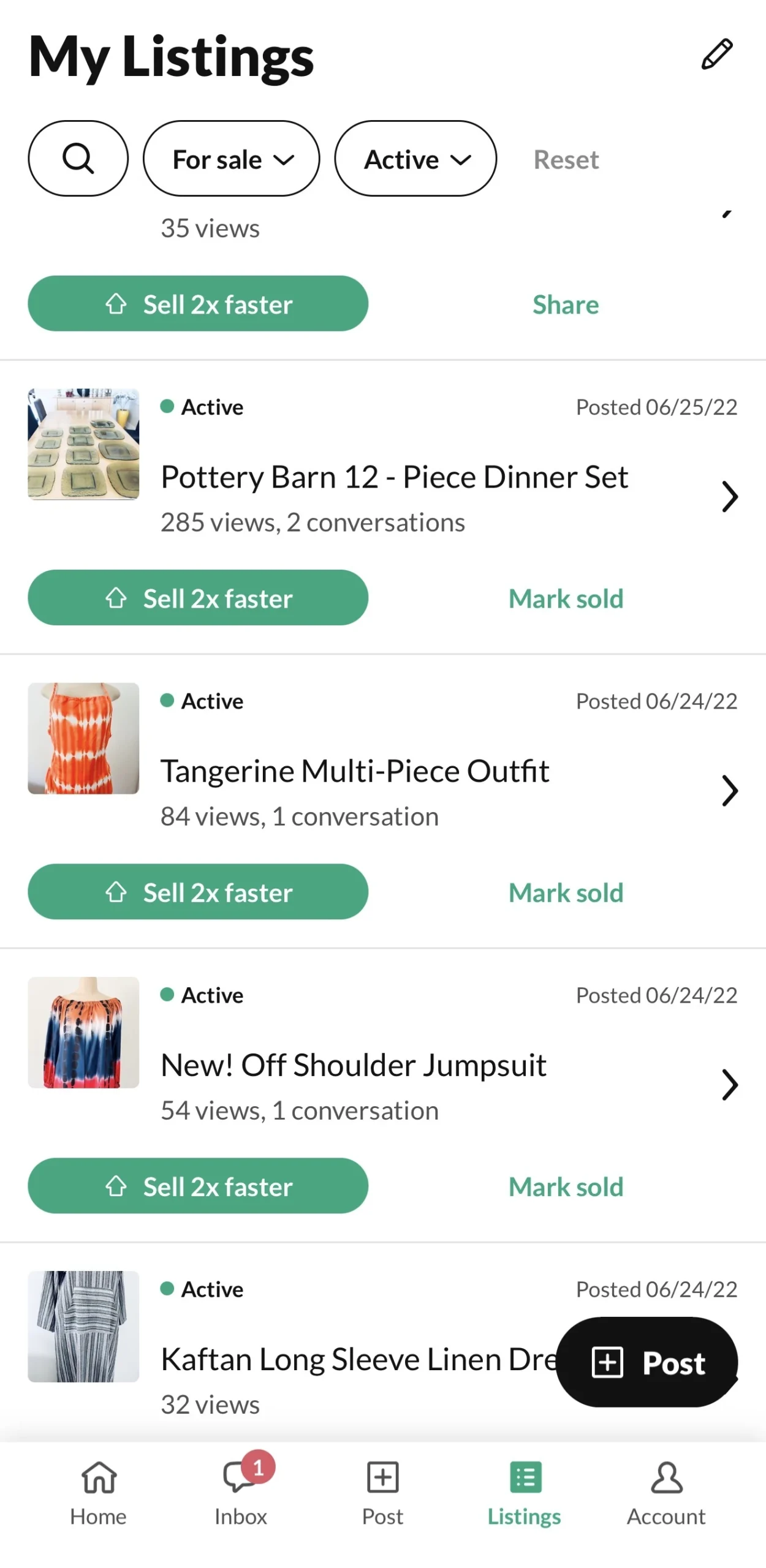
You've probably noticed the "Sell 2x faster" button in my own screenshots. That's OfferUp offering paid promotion.
OfferUp says promoted listings receive placement near the top of buyers' feeds, and it currently offers individual promotions as well as a Promote Plus subscription.
I see those as tools - not requirements.
If I'm starting with an ordinary household item, I'm concentrating first on a good item, good pictures, a useful description and a reasonable price.
If I have a higher-value item that's sitting longer than I'd like, then I can decide whether paying for additional visibility makes economic sense.
I wouldn't spend $10 trying to create urgency around something I'm only going to make $25 selling.
Turn unused things into cash - not create a new category of expenses.
Active Doesn't Mean Failed
This is where I want to show you the other side of my OfferUp account. I still have active listings: furniture, dinnerware, clothing. Different categories. Different amounts of interest.
An active listing isn't cash. But it also isn't necessarily a failure.
If I'm not urgently trying to clear it out, sometimes I'll let it sit. I can always reconsider later: lower the price, improve the photographs, rewrite the description, pay for promotion if the economics make sense, cross-list somewhere else, donate it, or decide that I simply want my space back.
Don't Confuse Your Asking Price With Your Money
This is something I've learned across resale platforms.
I can list a table for $200. That doesn't mean I have $200. I can receive 1,000 views. Those aren't dollars either. I can have 13 conversations. Still not money.
The financial result happens when someone actually agrees to buy the item and the transaction is completed.
An asking price isn't money. A sold item is.
That principle matters because sometimes holding out indefinitely for the number in my head costs me something too - even if the cost is simply living with an item I no longer want.
One More Difference With Local Sales: Inspect Before You Pay
OfferUp's current model places substantial importance on the meetup itself. For local transactions, buyers are told to inspect the item and resolve concerns before paying; once money changes hands, the sale is final.
That makes transparency even more important to me as a seller.
I want the buyer to inspect the item. Test electronics when practical. Look at the condition. Ask questions. Know what they're taking home.
I want a successful transaction - not a surprised buyer.
So, Is OfferUp Worth It in 2026?
For me, yes - when I use it for the job it does well.
I'm not looking at OfferUp as a replacement for every resale marketplace. I'm looking at it when I have something with value that I'd rather sell locally than pack and ship.
Sometimes that's furniture. Sometimes electronics. Sometimes something much smaller.
My own selling history has taught me that there isn't one predictable formula for how quickly something will move. Some items find their buyer with relatively little activity. One pair of tables made me wait almost three years.
That's why I don't judge OfferUp solely by how quickly something sells. I ask:
Do I need the money now? Do I need the space now? Or can I afford to let the listing wait for its buyer?
Those answers determine my pricing and my patience.
Before you assume you need another side hustle, another job or another stream of inventory, take another walk around your house.
There may be something sitting there that you've stopped using but someone in your local market is looking for right now.
And if they aren't looking for it today? Maybe they will be next month. Or, apparently in my case, three years from now.
List it. Price it with your actual goal in mind. Let the local market tell you what happens next.