
Article URL: https://everydaywerk.com/mercari-review/
Quick Take
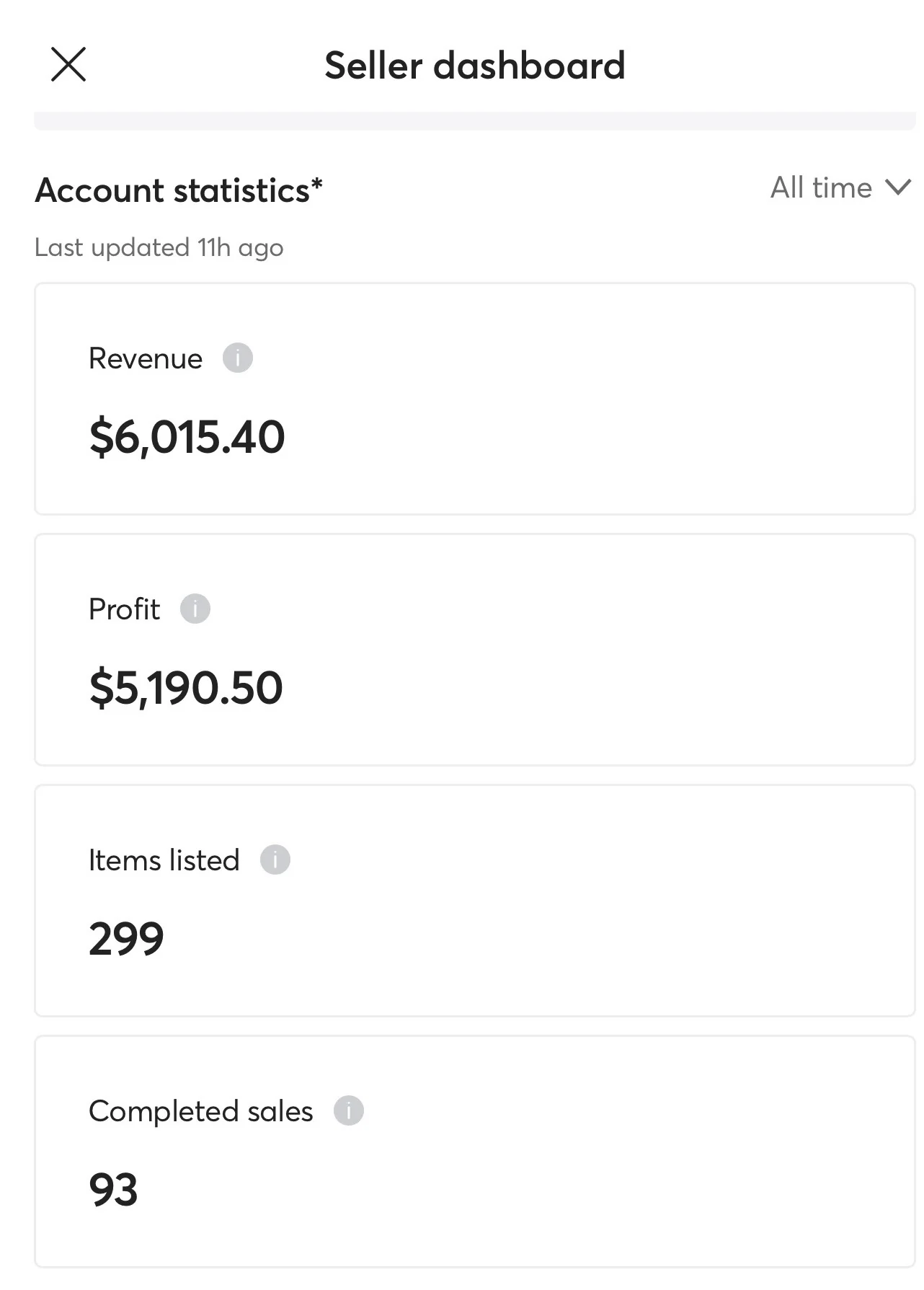
I've used Mercari for years to turn clothes, handbags, electronics and other things I'm no longer using into extra cash. My seller dashboard currently shows more than $6,000 in all-time revenue and more than $5,000 in profit across 93 completed sales.
It's become one of my go-to resale apps because I can sell across categories and Mercari provides tools that help sellers identify opportunities, promote listings and reach buyers. But making a sale still takes work. Good photography, accurate descriptions, realistic pricing and understanding what you'll actually keep after fees and shipping all matter.
My strategy: Start with what you already own. List what has enough value to justify the effort. Present it well. Use the tools available to help it sell. Price for what you'll actually keep. Turn unused stuff back into usable money.
Table of Contents
Before You Look for More Work, Look at What You Already Own
There have been times when I needed additional cash and my first instinct wasn't to find another job or start another business.
I looked around my house.
Clothes I wasn't wearing. Handbags sitting in the closet. Shoes. An old iPhone. An Android phone I'd upgraded from. A computer I wasn't using anymore.
I'd already spent the money. But that didn't necessarily mean all of the value was gone.
Mercari has been one of the apps I've used most over the years to turn those things back into usable cash.
I've sold across a pretty wide range of categories—from everyday clothing and accessories to technology and several Louis Vuitton handbags. While I used eBay quite a bit years ago, over roughly the last five or six years, Mercari has become my go-to when I'm looking through my closet or around my house and thinking, I'm not using this anymore. Could someone else be willing to pay for it?
Very often, the answer has been yes.
And that's why I think of reselling differently than simply “getting rid of stuff.”
Sometimes you're sitting on inventory you didn't realize you had.
Quick Facts: Mercari in 2026
| Best for: | Clothing, handbags, shoes, electronics, collectibles and other shippable items you already own, including eligible higher-end designer goods |
| Cost to list: | Free |
| Current seller fee: | 10% of the item price plus buyer-paid shipping on applicable listings. Fees can change; verify current pricing before listing or accepting an offer. |
| Designer authentication: | Available for eligible luxury brands/categories through Real Authentication, an independent third-party service. Current fees and eligibility apply. |
| Shipping: | Buyer-paid or seller-paid Mercari prepaid label; seller can also ship independently |
| Getting paid: | Earnings are released after the transaction is completed |
| Cash-out: | Free successful ACH direct deposit or $3 Instant Pay |
| Instant Pay: | Typically within minutes; may take up to 30 minutes depending on the bank |
| ACH: | Direct Deposit requests are processed the following business day and can take up to 5 business days to appear; I wouldn't plan around the fastest possible arrival. |
| My take: | One of my go-to marketplaces when I want to turn things I already own into cash |
Your First Sale Can Change the Way You Look at Your Stuff
There's something about making that first sale.
Suddenly, the handbag you haven't carried in two years isn't just taking up space.
The phone you replaced six months ago isn't just sitting in a drawer.
The shoes you loved in the store—but somehow never wear—aren't necessarily a sunk cost.
You start realizing that some of the things you've accumulated still have value. And some of that value may be convertible back into cash.
That's an important mindset shift, particularly when money is tight.
I'm not suggesting that selling a few things around your house replaces adequate income or emergency savings. It doesn't.
But if I need additional cash, I like knowing there are some levers I can pull that are already under my control.
One of those is simply asking:
What do I already own that I'm no longer using—but someone else might value?
My Results So Far
Over the years, I've generated more than $6,000 in revenue and more than $5,000 in profit through my Mercari account, across 93 completed sales. That's not full-time reseller income—and that was never my goal. For me, it's money recovered from clothing, handbags, electronics and other things I already owned and was no longer using.
Make a Day of It: “Shop” Your Own House
Here's where I'd start if you've never done this before.
Don't try to inventory your entire house.
Pick one area.
Maybe Saturday morning becomes closet day. Put on some music. Grab your coffee. Open the closet and actually look at what's in there.
Pull out the handbag you haven't carried in three years.
The coat you haven't worn in two winters.
Those shoes.
You know which shoes I'm talking about.
Then move beyond the closet. What about that previous-generation phone? Tablet? Computer? Small appliance? Electronics sitting in a drawer?
Instead of asking, Do I want this?, ask another question:
Would someone else pay me for this?
Create three piles: Keep. Donate. Potentially sell.
Don't worry yet about creating perfect listings for everything in the sell pile. You're simply taking inventory.
Not sure what might be worth listing? Mercari also gives sellers listing ideas based on popular brands, categories and areas of demand. I wouldn't buy something simply because Mercari says it's trending, but when I'm already looking around my house for things to sell, these insights can help me think differently about what might have a market.

This is also where I eventually want to help Everyday Werk readers go a step further—actually documenting what they own, what they originally paid, what similar items may be selling for now and which marketplace may make the most sense.
Because the goal isn't to convince yourself that you have $2,000 sitting in your closet.
An asking price isn't cash.
The goal is to identify assets that might realistically be converted into money and then create a plan for doing it.
What I've Sold on Mercari
One reason Mercari has remained useful to me is that I haven't had to put myself into one particular seller category.
I've sold clothing. Shoes. Everyday handbags. Higher-end handbags, including several Louis Vuitton pieces. iPhones and Android phones. Computers and other technology I was no longer using.
That's important because your own inventory probably isn't going to fit neatly into one category either.
And I've learned something else from selling on multiple platforms: the same item doesn't necessarily perform equally everywhere.
I may list an item on Mercari and also put it on Poshmark or another appropriate marketplace. That gets the item in front of different audiences and helps me see where there's actual demand.
If it sells on one platform, though, take it down from the others quickly. You don't want two people buying the one item you actually have.
The Biggest Work Isn't Listing. It's Presentation.
Technically, putting an item on Mercari isn't particularly difficult.
Doing it well takes more effort.
For me, one of the biggest lifts has always been getting good photographs.
I've actually cleared out a room so I could have a clean area with good lighting for photographing things I planned to sell.
Why go through that trouble?
Because somebody scrolling through Mercari can't pick up my handbag. She can't turn it around. She can't unzip it. She can't examine the corners. She can't hold the shoes up to the light.
My photographs have to do that job for her.
Take Pictures That Help Someone Buy
Before I photograph something, I make sure it's clean and presented the way I'd want to receive it.
- the entire item
- front and back
- different angles
- labels or identifying details
- important features
- the actual condition
- any damage or wear
If there's a scratch, photograph the scratch. If the corner of the handbag has wear, show the corner. If the shoes have been worn, show the soles.
Transparency doesn't make a good listing weaker. It makes the buyer more confident about what she's actually buying.
That's particularly important when I'm selling something more expensive.
You can certainly use editing tools to clean up a distracting background or make the item easier to see. But there's a big difference between improving the presentation of an image and altering an image so the product looks better than it actually does.
I want my buyer to open that box and see what she expected.
That's been part of how I've maintained five-star seller experiences across the platforms I've used.
Your Description Has a Job Too
Once the pictures are good, don't phone in the description.
Tell me what it is. Tell me the condition. New with tags? New without tags? Original packaging? Previously worn? Gently loved? Are there scratches, stains or other imperfections? Say so.
If I'm buying something online from a stranger, uncertainty makes it easier for me to keep scrolling.
A strong listing reduces that uncertainty.
And there's a practical reason to be thorough: Mercari's current return policy allows buyers to request a return within 72 hours of delivery for qualifying issues such as an item being significantly different from its listing, damaged in shipping or inauthentic.
Accurate descriptions and photographs aren't just good marketing. They're seller protection.
Mercari Gives You Tools to Help Make the Sale
Listing the item isn't necessarily the end of the work. Mercari also gives sellers promotional tools that can help put a listing back in front of potential buyers.
In my account, I can run a time-limited sale, promote an item by reducing its price or send a special offer to people who have liked it. Each option works differently and has its own requirements, so I check the current terms before using one.
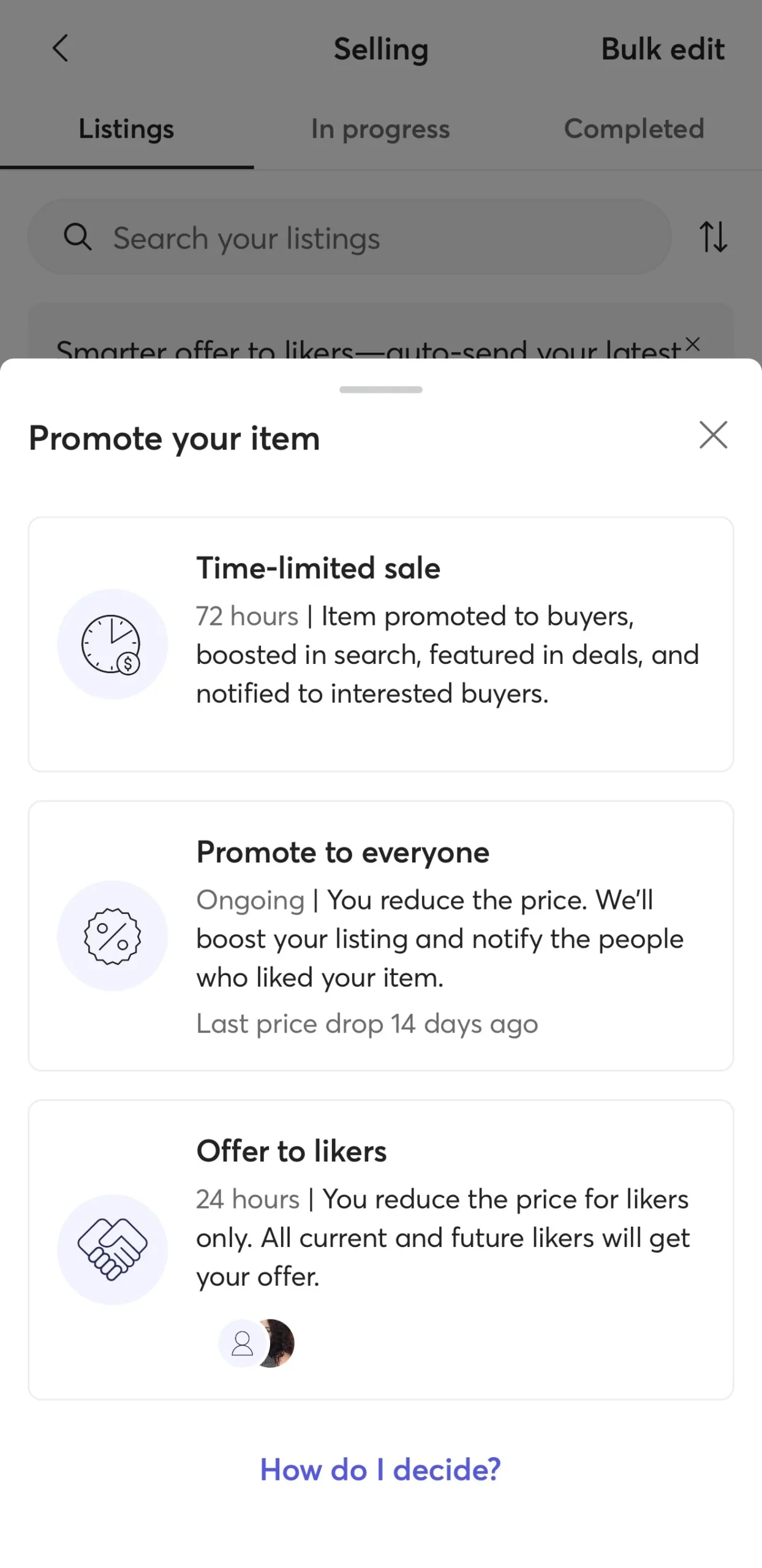
I like having those tools because sometimes an item doesn't need a completely new listing. It may simply need another opportunity to get in front of the right buyer.
Mercari also periodically runs buyer-facing promotions in selected categories. If something I've listed happens to qualify, that's another opportunity for my item to benefit from activity Mercari is generating on the marketplace. Promotions vary, though, so I don't count on them when deciding whether something is worth listing.
And that's something I appreciate about marketplaces like Mercari: they have an incentive to help you sell. When you successfully complete a transaction, the marketplace succeeds too.
What Does It Cost to Sell on Mercari in 2026?
Listing an item is free.
But selling it isn't.
Mercari's current seller fee is 10% of the item price plus buyer-paid shipping for applicable current listings. Mercari separately charges buyers a 3.6% Buyer Protection fee based on the item price and buyer-paid shipping.
That means I don't look at a $100 sale and automatically think: Great. I made $100.
I want to know what I actually keep after: Selling fee + any shipping I'm paying + packing expenses or other selling costs = my actual proceeds.
That number matters—especially when deciding whether an item is worth listing in the first place.
WERK NOTE
Mercari's seller fees, buyer fees and shipping rates can change, so don't assume the numbers you remember from your last sale are still current. Before you list—or accept an offer—check the current fees and shipping cost and calculate what you'll actually keep.
Price for the transaction you're actually going to have—not the dollar amount you wish you could keep.
Before accepting an offer, mentally work backward from the amount you'll actually receive.
Who Pays Shipping on Mercari?
You have choices.
With a Mercari prepaid shipping label, you can have the buyer pay the shipping, in which case the shipping charge is added at checkout.
Or you can offer free shipping to the buyer and pay the label cost yourself; Mercari deducts that cost from your sales profit.
I've found that this is worth thinking about as part of the total offer.
If I'm trying to maximize how much cash I'm getting from the sale, having the buyer pay shipping may make more sense.
If I'm trying to make my listing particularly attractive—and the economics still work—I may decide that free shipping helps the offer.
But “free shipping” isn't actually free. Somebody is paying for it. If it's you, build that into your pricing decision.
Mercari also lets sellers ship on their own. However, Mercari says independently shipped packages don't qualify for Mercari Shipping Protection, while qualifying Mercari prepaid-label shipments can receive protection subject to its requirements.
And don't guess at package weight and dimensions. Mercari says sellers are responsible for selecting the correct shipping category and dimensional weight.
How Fast Does a Mercari Sale Become Usable Cash?
This is one of the questions I care about most.
Because “I sold it” and “I have the money” are not the same thing.
Here's the basic path:
List → Sell → Ship → Deliver → Transaction completes → Funds released → Transfer → Usable cash
After carrier-confirmed delivery, the buyer generally has 72 hours to review the order and either rate it or raise an eligible issue. If the buyer doesn't rate during that period and no qualifying issue interrupts the transaction, Mercari can automatically complete the transaction. Once the transaction is complete, your earnings become available in your Mercari balance.
Then you decide how quickly you need the money.
Free ACH Direct Deposit
Mercari offers free successful ACH withdrawals to a checking account. Its current payout guidance says Direct Deposit requests are processed the following business day and funds can take up to five business days to appear. I would personally plan around the longer end rather than count on the fastest outcome.
Instant Pay
If speed matters more, eligible sellers can use Instant Pay to an eligible debit card.
Mercari currently charges $3 per Instant Pay withdrawal. Funds typically arrive within minutes but can take up to 30 minutes depending on the bank. Instant Pay currently allows one withdrawal per day and up to $600 per month, and requires identity verification and an eligible Visa or Mastercard debit card.
This is where I would make a very practical decision.
If I have $35 sitting there and don't need it immediately, am I giving up $3 just to have it today? Probably not.
If I have several hundred dollars available and I'm using that money to close an immediate cash gap? That $3 might be worth it to me.
Speed has a price. Decide whether you actually need to pay it.
My Closet-to-Cash Test
Here's the question I increasingly use when I look at something I'm no longer using:
I already own it. I'm not using it. How much effort will it take to turn it into usable money?
That's different from simply asking what something is “worth.”
Suppose I own something I could theoretically sell for $25.
If I need to clean it, photograph it, measure it, research it, create a listing, negotiate with buyers, find packing material, drive somewhere for shipping and ultimately net $12—is that worth my time?
Maybe. Maybe not.
Now make that a $300 handbag or a $400 phone.
Very different calculation.
Your time is part of the transaction.
Don't Overlook Higher-Value Things
When people hear “sell things around your house,” I think it's easy to picture a garage sale.
That's not necessarily what I'm talking about.
Some of my Mercari sales have included higher-end designer handbags and technology. I've sold several Louis Vuitton bags on the platform, along with phones, computers and other items that had meaningful resale value.
So while you're inventorying your house, don't only look for volume.
Look for value.
An older phone may still have a market. A designer handbag you haven't carried in years may have retained meaningful resale value. A computer you've replaced may still meet someone else's needs perfectly.
That doesn't mean every expensive thing you own should be sold. It means unused doesn't automatically mean worthless.
Selling Designer Goods? Mercari Has an Authentication Option
One reason I've been comfortable using Mercari for higher-end designer pieces is that the platform has an authentication process for eligible luxury items.
Mercari Authenticate uses an independent third-party authentication service, Real Authentication, to evaluate certain handbags, wallets, designer shoes, eyewear, jewelry and watches. Depending on the brand, category and price, authentication may be optional or required.
The process is photo-based. Mercari guides the seller through the specific images needed, which may include logos, serial numbers, tags, engravings and other identifying details. If Real Authentication determines that the item meets its authentication standards, the listing can receive an authentication badge and a boost in search.
There is currently a $5 authentication fee, with an optional $10 certificate for eligible categories. Eligibility, thresholds, pricing and requirements can change, so check Mercari's current authentication terms before listing a higher-value item.
For me, that's especially useful when I'm selling something like a designer handbag. A buyer can't stand in my closet and inspect the bag herself. Anything that helps establish trust around an expensive online purchase can make the transaction more comfortable for both sides.
For particularly valuable pieces, Mercari currently allows eligible authenticated items to be listed for up to $5,000 after additional identity verification.
Watch Out: Higher Value Means More Responsibility
The more valuable the item, the more deliberate I want to be.
Document the condition thoroughly. Photograph identifying details. Use accurate descriptions. Understand the platform's current seller protections. Follow the shipping requirements carefully. Keep records of the transaction.
And if you're selling designer goods, authenticity matters. Mercari's return policy specifically includes potentially inauthentic or counterfeit items among the reasons a buyer may request a return.
I want the documentation surrounding a higher-value sale to be as strong as the listing itself.
Is Mercari Good When You Need Cash Quickly?
It can be.
But there's an important word in that sentence: Sell.
You can create a beautiful listing today. That doesn't mean somebody buys it today.
That's why I don't want to describe Mercari as instant money.
Once an item sells and the transaction completes, Mercari provides a relatively straightforward route to getting your proceeds out of the platform. But the unpredictable part is how long it takes to find the buyer.
That's where good inventory, realistic pricing, strong photography, clear descriptions and exposure matter.
If I'm trying to generate cash from things I own, I may also cross-list appropriate items on more than one marketplace rather than assuming every buyer is shopping in the same place.
The Part I'd Do Differently: Track What I'm Selling
One thing I wish Mercari made more motivating for me is seeing the cumulative story of everything I've sold over the years.
I keep archived reports of what I've sold each year, but I'd love to have that big number staring back at me:
You've turned $X of things you weren't using into cash.
Because I think that number would be incredibly motivating.
It also changes the way you think about this from occasional decluttering into something more intentional.
How much did I list? How much actually sold? What categories sold fastest? What did I net after fees? Which marketplace performed best? How long did things sit before selling?
Those are the questions that can make you better at this over time.
Start With One Closet
You don't need a reseller business.
You don't need inventory delivered to your house.
And you certainly don't need to go shopping for things to sell.
Start with what you already own.
Pick one closet. One dresser. One storage area. One electronics drawer.
Give yourself a couple of hours and see what you find.
You might discover five things worth listing. You might discover 25.
Some won't sell. Some may sell for less than you hoped. And occasionally, something you barely thought about may be exactly what someone else has been searching for.
That's part of what makes this fun.
Your first goal isn't to build an empire.
Your first goal is to make one sale.
Because after you've taken something you weren't using, presented it well, found someone who wanted it and turned it back into actual money, you start looking around your house a little differently.
So, Is Mercari Worth It in 2026?
For me, yes—as one of the tools I use to sell things I already own.
It's especially useful to me because my inventory isn't limited to one category. I've sold clothing, shoes, handbags, designer pieces, phones, computers and other items over the years.
But I don't think the question should simply be “Is Mercari worth it?”
The better questions are:
What do I have to sell? How much could I realistically net? How much work will the sale require? And how quickly do I need the money?
Mercari is one place where I've been able to put things I no longer use in front of people who may value them.
And sometimes the extra money you're looking for isn't attached to another shift, another client or another job.
Sometimes it's already sitting in your closet.