Article URL: https://everydaywerk.com/books-about-midlife/
Some links in this article may be affiliate links, which means Everyday Werk may earn a commission if you make a purchase through them, at no additional cost to you. We only recommend products and services we believe are worth considering.
As an Amazon Associate I earn from qualifying purchases.
There is a lot of language around midlife that needs an update.
Crisis.
Decline.
Anti-aging.
Empty nest.
Slow down.
Prepare for retirement.
As if we spend the first half of our lives becoming—and the second half slowly becoming less.
We're not buying it.
Yes, the middle comes with change.
Bodies change. Families change. Careers change. Relationships change. Parents get older. Children need us differently. Time suddenly feels more visible than it did at 25.
But something else happens too.
You know more.
You've survived some things.
You've accomplished some things.
You've gotten some things spectacularly wrong and discovered that the world didn't end.
You know more about what you're good at. You're clearer about what you're no longer willing to tolerate. And maybe—just maybe—you care a little less about getting everyone else's approval before deciding what works for you.
That's not decline.
That's perspective.
And there's a particular kind of freedom that can come with it.
The books on this list aren't about trying to become 30 again. They're about understanding, enjoying and sometimes completely reimagining the woman you are right now.
Some are practical. Some are research-driven. Some will introduce you to women doing midlife differently. And at least one may simply make you laugh and think, Thank God somebody finally said it.
Because maybe the middle isn't something we need to get through.
Maybe there's some magic in it.
Table of Contents
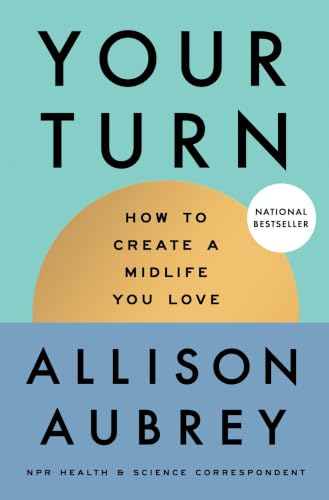
When you're asking: I've spent years taking care of everything. What do I want this part of my life to look like?
There couldn't be a more timely book to open this list.
Published in September 2026, Your Turn grew partly out of NPR health and science correspondent Allison Aubrey's own experience of reaching midlife and confronting questions about identity, purpose and what comes next. She then set out to learn from people who were thriving during this stage of life.
The result explores purpose, health, connection and the possibilities that can open when we approach midlife more intentionally.
And we love the premise embedded right there in the title:
Your turn.
Not because you haven't mattered until now.
But because so much of adulthood can be about responding to what needs you.
Work needs you.
Children need you.
Parents need you.
Partners need you.
Bills certainly need you.
Your calendar belongs to everybody.
And somewhere in there, it can become surprisingly easy to stop asking:
What do I need?
Why We Like It
We like that this isn't simply a book about starting over.
Because maybe you don't want to start over.
Maybe you like quite a lot about the life you've created. You just want to become more intentional about what stays, what goes and what gets added from here.
That's an important distinction.
Midlife doesn't have to require blowing up your life to prove you're changing it.
Sometimes reinvention is dramatic.
A new career. A new city. A new relationship.
But sometimes it's quieter.
You protect your mornings.
You finally take the trip.
You start creating again.
You stop volunteering for responsibilities you don't actually want.
You prioritize your health.
You reconnect with people you miss.
You decide that your time is valuable enough to be treated like it belongs to you.
Those changes may not look revolutionary from the outside.
They can feel revolutionary from the inside.
Read This If...
You've spent a lot of years asking:
What needs to get done?
And you're ready to add another question:
What would make this part of my life feel good to live?

When you're asking: What could the next few decades actually look like?
One of the strangest things about midlife is realizing that “the rest of your life” could still be a very long time.
At 50, 55 or 60, we're not necessarily talking about a five-year epilogue.
Potentially, we're talking about decades.
So perhaps the more useful conversation isn't simply how to age.
It's how to live those years well.
In The Second Fifty, aging expert Debra Whitman examines some of the major questions surrounding the second half of life, drawing on research around health, purpose, relationships, work, finances and longevity.
Why We Like It
Because perspective is powerful—but so is information.
We can talk all day about embracing midlife, but there's something empowering about understanding the realities of longer lives and making choices accordingly.
If there's potentially a lot of life ahead, decisions about health, money, relationships, work and purpose aren't side conversations.
They're part of designing the life.
And that shifts the mindset from:
How do I hold onto what I have?
to:
What am I building for?
That's a subtle shift, but an important one.
One question is mostly about preservation.
The other leaves room for possibility.
Read This If...
You're beginning to think beyond the next year or two and wondering what you want your 60s, 70s and beyond to feel like—not just financially, but physically, socially and emotionally.
This one is less pep talk and more perspective.
And sometimes perspective is exactly what gets you moving.

When you're asking: Who says your most interesting thing has already happened?
This is why we didn't want our entire list to consist of traditional self-development books.
Sometimes you don't need someone to explain reinvention.
You need to see it.
Zarna Garg's story offers exactly that.
Her memoir traces a remarkable life that began in India, included leaving home as a teenager and eventually building a family in America—and then, later in adulthood, entering stand-up comedy and creating a career that would have been difficult to predict from the earlier chapters of her life.
This American Woman was published in 2025.
Why We Like It
Because there's something wonderfully disruptive about watching a woman become more visible as she gets older.
So much of the cultural conversation around women and aging has historically suggested the opposite.
Disappear gracefully.
Make room.
Become less ambitious.
Don't be too loud.
Don't start too late.
And then someone comes along and says, essentially:
Actually, I think I'll become a comedian.
We need stories like that.
Not because everyone should pursue stand-up comedy at 40, 50 or 60.
But because every example of a woman beginning something unexpected expands our imagination about what beginning can look like.
Read This If...
You need a reminder that your résumé is not a prophecy.
The fact that you've spent decades doing one thing doesn't mean the next thing has to look anything like it.
And sometimes the most interesting version of you may be the one you haven't met yet.

When you're asking: Why does every conversation about women in midlife seem to start and end with menopause?
Hormonal changes matter.
Health matters.
Menopause matters.
But women in midlife are also navigating careers, relationships, aging parents, money, identity, children, changing bodies, friendships, purpose and a growing awareness that time is not an unlimited resource.
That's a much bigger conversation.
Published in 2025, Midlife Matters deliberately takes that broader view, exploring women's health alongside wellbeing, relationships, work, challenges and opportunities.
Why We Like It
Because women are whole people.
We don't suddenly become a collection of symptoms when we hit a certain birthday.
Yes, understanding what's happening physically can be enormously important.
But so is asking:
What am I learning about myself?
Which relationships still fit?
How do I want to work?
What do I want my money to make possible?
What am I carrying that I can finally put down?
What am I ready to make room for?
That's the fuller midlife conversation we want Everyday Werk to participate in.
Read This If...
You're looking for a broader perspective on this stage of life—one that acknowledges physical change without reducing the entire experience of being a middle-aged woman to it.
You are more than what's happening to your hormones.

When you're asking: What if some of the rules about getting older are simply outdated?
At some point, age can quietly start entering the conversation about what's possible.
Is it too late to change careers?
Too risky to start a business?
Too unrealistic to learn something completely new?
Should I be thinking about slowing down instead of gearing up?
The Age Rebellion challenges some of those assumptions, including the traditional idea that life should follow a predictable sequence: education, career, retirement.
Because when people are living and working longer, some of the old timelines stop making as much sense.
And that raises a much more interesting question:
What if age isn't telling you to stop? What if it's simply asking you to rethink the timeline?
Why We Like It
Because some of what we interpret as personal limitations are actually cultural expectations we've absorbed.
At a certain age you're supposed to slow down.
At a certain age changing careers becomes risky.
At a certain age starting a company seems unusual.
At a certain age you should be thinking about exiting rather than entering.
But longer lives change the math.
And women who have accumulated decades of knowledge, relationships, resilience and professional experience may have considerably more to build with than we give ourselves credit for.
WERK Note
Before deciding you're “too old” for something, ask yourself whether that's actually your belief—or a rule you inherited without ever agreeing to it.
Read This If...
Age has quietly started appearing on your list of reasons not to do something.
This book may make you question who put it there.

When you're asking: Can we please talk about midlife without making everything so serious?
Yes.
Please.
Because midlife can contain grief, uncertainty, caregiving, physical changes and enormous transitions.
It can also be absurd.
Funny.
Liberating.
Messy.
And occasionally the exact moment when you realize you no longer have the energy to pretend something makes sense when it clearly doesn't.
Published in 2025, Cathrin Bradbury's This Way Up brings humor, candor and personal reflection to the experience of navigating the far side of midlife.
And that gives this list something it needs:
Levity.
Why We Like It
Because not every realization needs to become homework.
Sometimes recognition itself is valuable.
That moment when another woman describes something you've experienced and you think:
YES. THAT.
There's connection in that.
And there's freedom in being able to laugh at some of the strange contradictions of getting older rather than treating every change as another problem requiring optimization.
We're allowed to learn.
We're allowed to change.
We're also allowed to laugh.
Read This If...
You're tired of books that approach midlife as though you've been assigned a complicated improvement project.
Sometimes you want insight.
Sometimes you want company.
And sometimes you want someone who can make you laugh while giving you both.

When you're asking: What am I finally allowed to stop caring about?
Let's clarify something immediately.
We're not talking about becoming careless.
We're not talking about becoming selfish.
And we're definitely not suggesting that reaching midlife gives you permission to stop caring about the people and things that genuinely matter to you.
We're talking about something much more specific.
The things that have been taking up your energy without earning it.
The pressure to look a certain way.
The need to explain every decision.
The guilt that shows up when you say no.
The expectation that you should keep everybody comfortable.
The exhausting habit of wondering what everyone else thinks before asking yourself what you think.
Published in 2026, Melani Sanders' The Official We Do Not Care Club Handbook grew from the We Do Not Care movement, a humorous community built around the realities—and absurdities—of perimenopause, menopause, motherhood and midlife.
The book is funny and intentionally irreverent.
But underneath the humor is something we think a lot of women will recognize:
I'm tired of spending energy on things I don't actually care about.
Why We Like It
Because maybe one of the privileges of getting older is becoming more selective.
Not less caring.
More discerning about what earns your care.
You can care deeply about your family and stop caring whether everyone approves of your choices.
You can care about your health and stop chasing every impossible beauty standard.
You can care about your work and stop believing your worth depends on a title.
You can care about your relationships and stop saying yes every time someone asks something of you.
You can care about being a good person without volunteering to be everything to everybody.
Maybe that's part of what experience gives us.
Not permission to care about nothing.
Permission to decide what matters.
Read This If...
You're exhausted from performing, pleasing, comparing, explaining or trying to meet expectations you never consciously chose.
Maybe you've reached the point where you don't want to spend the next chapter of your life asking:
What will everybody think?
You'd rather ask:
Do I care?
And if the answer is no?
Maybe that's information too.
WERK Note
Midlife isn't about caring less. It's about getting clearer about what deserves your energy—and giving yourself permission to release some of what doesn't.
Maybe This Is the Magic
Maybe the magic of midlife isn't that everything suddenly becomes easier.
It doesn't.
You can know yourself better and still have doubts.
You can be wiser and still make mistakes.
You can feel grateful for the life you've built and still want something different.
You can love people deeply and realize you need more space for yourself.
You can be confident one day and wonder what on earth you're doing the next.
The magic isn't perfection.
Maybe it's perspective.
You've lived long enough to know that some things you once thought would destroy you didn't.
Some things you desperately wanted turned out not to matter nearly as much as you expected.
Some disappointments redirected you.
Some endings eventually made room.
Some mistakes became stories.
And some of the things you worried endlessly about never happened at all.
You know more now.
Not everything.
More.
And perhaps that's enough to start making different choices.
To wear what you like.
Go where you want.
Learn something new.
Earn differently.
Spend differently.
Love differently.
Rest without explaining yourself.
Start something nobody expects.
Change your mind.
And stop treating your age like evidence against your own possibilities.
There are things we lose as we get older.
We're not going to pretend otherwise.
But there are things we gain, too.
Experience.
Discernment.
Perspective.
Stories.
A better radar for nonsense.
And, if we're willing to claim it, a clearer sense that this life belongs to us.
Maybe that's the magic in the middle.
Not becoming younger.
Becoming more yourself.
Keep Reading
Your Next Chapter Starts Here — 7 books to help you figure out what comes next.
Make the Move — 7 books for when you're ready to stop thinking and start doing.